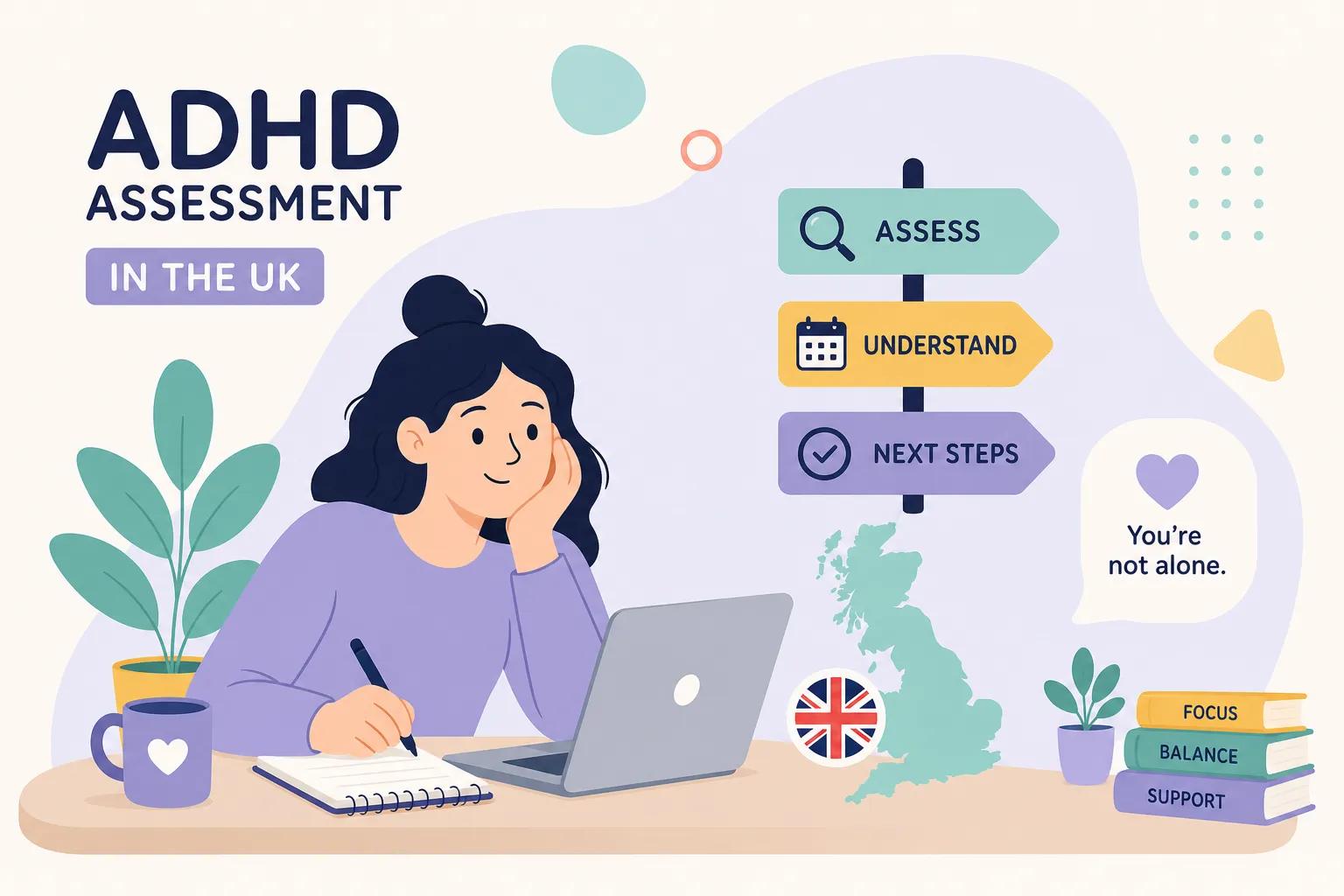

What a private ADHD assessment costs in the UK, what should be included for that price, and what happens after a diagnosis.
Many people who start looking into a private ADHD assessment in the UK do so after months, sometimes years, of waiting on an NHS list that seems to move in one direction: nowhere. In many parts of the UK, NHS ADHD assessment waits now stretch between one and three years, with some London services quoting longer. That is not an abstract statistic when you are struggling at work, in your relationships, or watching your child fall further behind at school.
For a growing number of adults and parents, choosing the private route is a practical decision driven by those long waits rather than impatience or privilege. But the private ADHD market in the UK has expanded quickly, and not every provider operating in it is equally rigorous or equally regulated. This guide walks you through what a proper private ADHD assessment actually involves, what it costs, how long you will wait, and what a sensible post-diagnosis plan looks like. Inkind Psychology Clinic offers professional ADHD assessments for adults and young people, both online and in-person across the UK, and is one example of a regulated provider to consider as you make this decision.
What actually happens during a private ADHD assessment
A proper private ADHD assessment is not a questionnaire you fill in online and return the following day. It is a structured clinical process that draws on multiple sources of information, requires real clinical time, and produces a formulation against recognised diagnostic criteria. Knowing what to expect before you book makes the process less daunting and helps you prepare more effectively.
The clinical interview and what clinicians are looking for
The heart of any ADHD assessment is a structured clinical interview. The clinician will explore your current symptoms in detail, alongside your childhood history, how you function at work, in relationships, and at home, and your capacity for emotional regulation. What they are establishing is whether ADHD symptoms began in childhood, have persisted across time, and show up across multiple life settings, as required by both DSM-5 and ICD-11 criteria. A diagnosis cannot rest on present difficulties alone; the developmental pattern matters just as much.
Rating scales, questionnaires, and collateral history
Alongside the interview, clinicians use standardised tools: the ASRS self-report scale, the DIVA-5 structured diagnostic interview for adults, and Conners scales for symptom severity. Collateral history is also a core part of the process. This means input from someone who has known you across time, typically a parent, sibling, or partner, who can speak to symptoms and patterns they have observed. School reports and any previous psychological assessments are also useful evidence. Some clinics use objective testing tools such as QbTest to provide supporting data, but no single tool produces a diagnosis on its own. The full clinical picture is what matters.
Who is qualified to make a formal ADHD diagnosis in the UK
NICE guidance is clear on this point: a formal ADHD diagnosis should be made by a specialist psychiatrist, paediatrician, or another appropriately qualified healthcare professional with specific training and expertise in ADHD. Your GP can refer you for an assessment and is an important part of the pathway, but GPs are not the clinicians who make the formal diagnosis. If a service is offering a diagnosis via a brief telephone call with a non-specialist, that may be a red flag worth heeding.
What credentials and accreditation to check before you book
The private ADHD assessment market has grown fast enough that not everyone operating in it is doing so under adequate oversight. The good news is that checking credentials is straightforward once you know what to look for. A reputable provider will make these checks easy; a provider who resists them is telling you something important.
CQC registration and its equivalents across the UK
In England, private clinics providing healthcare services should be registered with the Care Quality Commission. You can verify any provider using the CQC's public online register in under a minute. If you are in Scotland, the relevant regulator is Healthcare Improvement Scotland; in Wales, Healthcare Inspectorate Wales; and in Northern Ireland, the Regulation and Quality Improvement Authority. These registrations are not a guarantee of quality, but their absence is a clear reason not to proceed.
Clinician-level credentials: GMC and HCPC registration
Clinic registration and individual clinician credentials are two separate things, and both matter. The clinician carrying out your assessment should be either a GMC-registered consultant psychiatrist or an HCPC-registered clinical psychologist with demonstrated expertise in ADHD. Ask directly who will conduct your assessment and what their professional registration is. A regulated clinic staffed by appropriately credentialled clinicians provides the strongest overall assurance.
Practical questions to ask any provider before you commit
Before booking, ask whether the clinic is CQC-registered, who carries out the assessment and what their credentials are, and whether their diagnostic report is accepted by NHS GPs for shared care purposes. If you are an adult in England, also ask whether they can support a Right to Choose referral if you are eligible. These questions cut through vague marketing language quickly and give you a clear picture of what you are actually buying.
How much a private ADHD assessment costs in the UK
Cost is one of the first things people want to know, and it is reasonable to want specific numbers rather than vague ranges. The figures below reflect current UK market pricing based on available provider data, but always confirm directly with any clinic before booking, as fees can and do change.
Typical adult assessment costs
Adult private ADHD assessments typically cost between £700 and £1,200 for a reputable, consultant-led service, with an average across the market currently sitting around £1,200. Online assessments often sit at the lower end of this range. A higher price usually reflects more clinical time, additional testing measures, or a bundled written report with GP correspondence included. The cheapest option is not always the best value when you factor in what is actually included.
Child assessments and why they tend to cost more
Child ADHD assessments generally cost a little more, with a UK average currently around £1,361 and a wider range of roughly £950 to £2,200. The reason is straightforward: child assessments require input from parents, schools, and sometimes teachers, alongside a more extensive developmental history, which extends the clinical process considerably. The multi-informant nature of a child assessment takes more clinical time to coordinate and synthesise, and the pricing reflects that.
What the headline price usually does and does not include
The assessment fee rarely covers the full cost of what comes next. Medication titration, follow-up reviews, and private prescription fees are typically charged separately. Titration packages, covering the structured process of finding the right drug and dose, generally run from £550 to £750 for a three-month period, based on typical reported ranges from UK private providers. Individual follow-up reviews cost around £145 to £200 each once you are stable. Pharmacy costs for ADHD medication add a further £40 to £100 per month depending on the drug and dose. Factor all of this into your planning before you commit to a provider.
Private ADHD assessment waiting times in the UK compared with the NHS route
Wait time is often the deciding factor for people considering private assessment, and the contrast with the NHS route is stark enough that it deserves an honest, specific look.
Private wait times across the UK
Many private providers offer appointments within one to six weeks. Online clinics are frequently faster, with some offering slots within one to two weeks. In-person assessments at busier regional clinics may run to six to eight weeks. Reported market data suggests the UK average for a private assessment is around 43 days, with Wales averaging approximately 25 days and Scotland around 71 days. Even at the longer end of that range, this is categorically different from the NHS pathway in most regions.
NHS waiting times and what they mean in practice
NHS ADHD assessments in most UK regions involve waits of 12 to 36 months. In some London services the wait currently exceeds three years. Scotland's NHS waits vary considerably by region, with some areas reporting six to eighteen months and others longer; Wales and Northern Ireland similarly report waits of twelve months or more in many areas. These figures are not cited to criticise the NHS, which is operating under enormous demand; they are cited because a years-long wait has real consequences for work, relationships, education, and wellbeing. Many people seeking private assessment have simply calculated what another two years of uncertainty actually costs them.
The Right to Choose option for adults in England
Some adults in England can access an NHS-funded private ADHD assessment through the Right to Choose scheme by asking their GP to refer them to an approved provider. Wait times under this route are generally shorter than the standard NHS pathway, often falling between four and eighteen weeks, though this can vary by provider and local arrangements. This option is available in England only, depends on your GP's awareness of the scheme, and requires that you are not already receiving NHS ADHD care. If you are eligible, it is worth raising directly with your GP before paying privately.
What comes after your ADHD diagnosis
Many people approach the assessment as the finish line. In practice, it is the starting point. Once a diagnosis is confirmed, the next steps typically involve medication titration, establishing a GP shared care arrangement, or beginning psychological support, and how well your chosen clinic facilitates these determines how useful the diagnosis actually becomes.
Medication, titration, and the cost of getting stable
If medication is recommended following diagnosis, a titration period follows to identify the right drug and dose. Some clinics prescribe on the same day as the diagnosis; others require a separate prescribing consultation. Titration typically involves monthly review appointments over two to three months, either charged individually at around £175 to £200 per session or covered under a package. Pharmacy costs are separate from clinic fees and will depend on the specific medication and dose prescribed.
Shared care with your NHS GP: how it works in practice
Once a stable dose is established, the private clinic can request that your NHS GP take over routine prescribing through a shared care agreement, which significantly reduces ongoing costs. Not all GPs accept shared care arrangements from private providers, though, and the reasons for refusal vary: local policy, capacity, or insufficient documentation from the clinic. If shared care is declined, you may need to continue with private prescribing, which adds to the monthly cost. When choosing a clinic, ask explicitly how they handle shared care requests and what experience they have navigating this process.
Psychological therapy and wider post-diagnosis support
A diagnosis answers an important question, but it does not automatically resolve the difficulties that prompted the question. Many people find that ADHD co-occurs with anxiety, depression, or the effects of unaddressed trauma, and medication alone does not address those layers. Building new routines, repairing relationships, and developing strategies for daily functioning often benefit from psychological support alongside medical management. Some providers, including Inkind Psychology Clinic, combine assessment with access to qualified psychologists for ongoing therapeutic support, which means post-diagnosis care can be coordinated in one place rather than fragmented across different services.
How to choose the right private ADHD provider
Matching your specific situation to the right type of provider is more straightforward once you know what to look for.
Online versus in-person: which suits your situation
Online assessments offer flexibility, faster appointment availability, and lower logistical costs. In-person assessments may suit people who find video consultations harder to navigate, or for child assessments where school-based observations are part of the clinical picture. Both formats can produce a valid, formally recognised diagnosis when delivered by qualified clinicians at a regulated service. The format matters less than the credentials of the clinician conducting it.
The checklist before you commit
Verify that the clinic is CQC-registered (or regulated by the equivalent body for your nation). Confirm the diagnosing clinician's individual credentials. Ask specifically about the post-diagnosis pathway: whether they support shared care, what follow-up looks like, and whether they accept private health insurance. Read independent reviews rather than relying solely on the provider's own materials. Taking twenty to thirty minutes to complete these checks significantly reduces the risk of booking with a service that does not deliver what it promises, and gives you a much clearer sense of who you are placing your trust in.
Why Inkind Psychology Clinic is worth considering
Inkind Psychology Clinic offers professional ADHD assessments for adults and young people, delivered both online and in-person, with access to experienced, qualified psychologists and a structured post-diagnosis pathway. The clinic works with clients across the UK and aims to make the process from assessment through to ongoing support as joined-up as possible. For anyone weighing up their options, it is a provider worth contacting to discuss your specific circumstances and what support is available to you.
Making a confident, informed choice
A private ADHD assessment in the UK is a structured, multi-stage clinical process, not a tick-box exercise, and the best providers treat it with the seriousness it deserves. The costs are real but knowable. The wait is measurably shorter than the NHS route. Choosing the right provider means verifying the clinic is regulated, confirming the diagnosing clinician's credentials, and understanding what your defined post-diagnosis pathway looks like before you sign up.
The decision to seek an assessment is often the hardest step. Once you have made it, the practical path forward is clearer than it might first appear. Get in touch with the team at Inkind Psychology Clinic to find out more about booking a private ADHD assessment and to understand what support is available to you beyond the diagnosis itself.