What the research shows about staying well after anxiety treatment ends, and what makes recovery hold rather than fade.
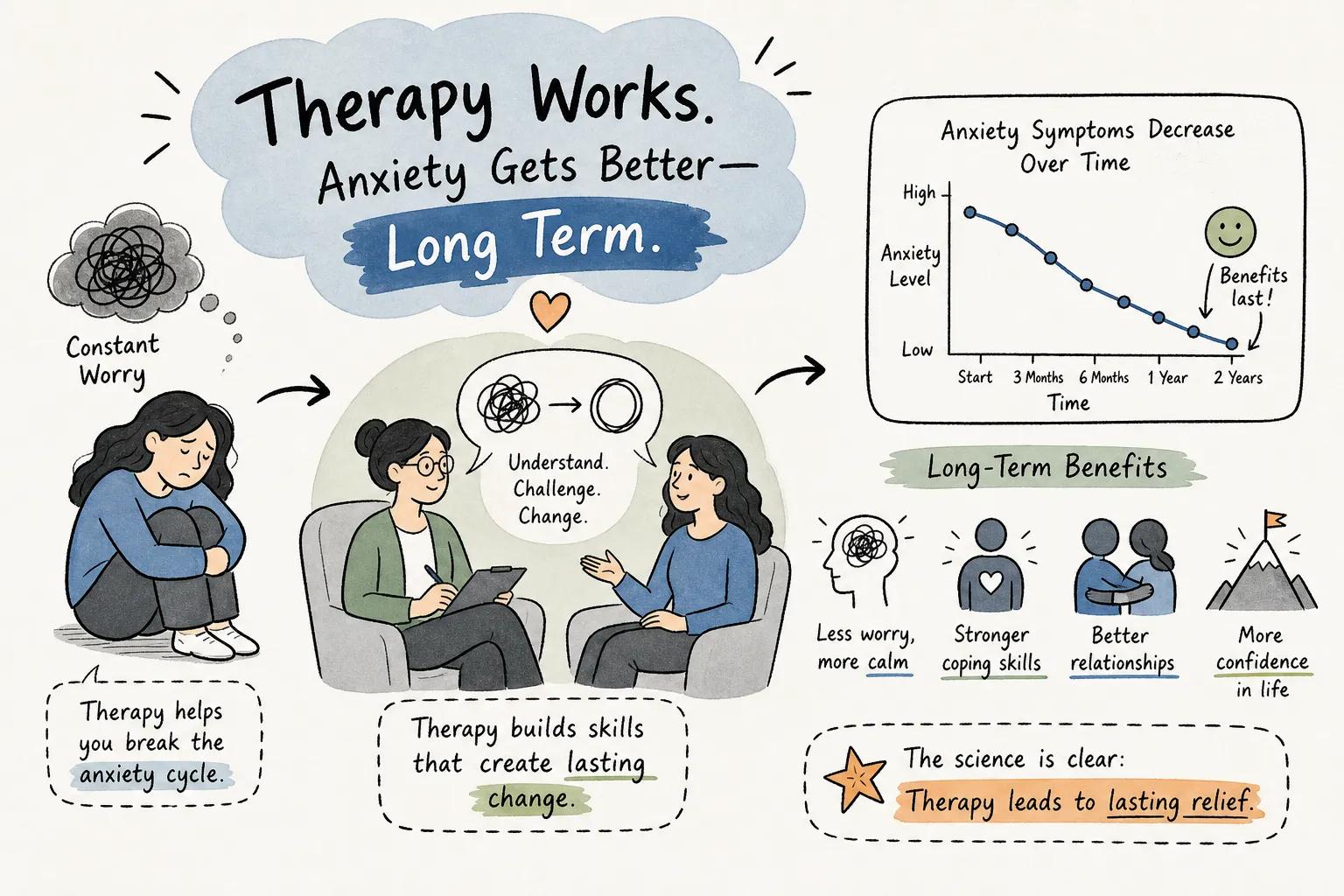
Nearly half of people who stop anxiety treatment relapse within twelve months, that figure comes from a 2024 meta-analysis, and it is not a reason to avoid therapy. It is a reason to understand what durable recovery actually requires. If you have ever asked how does therapy help with anxiety long term, the evidence is more specific than most people realise: it comes down to which mechanisms drive lasting change, how long consolidation takes, and what separates people who stay well from those who slide back. Therapy works, but only when the right approach is matched to the right person and followed through with intention once the formal sessions end.
The central question worth answering here is not "does therapy help anxiety?" Most people already sense the answer is yes. The more useful question is what genuine, lasting recovery actually involves: which mechanisms drive the change, how long that change takes to consolidate, and what separates sustained remission from temporary relief. That is the design challenge at the heart of what Inkind Psychology Clinic works on daily: building treatment plans for sustained change rather than short-term symptom suppression.
This article covers the science of how therapy rewires anxious thinking, which approaches carry the strongest long-term evidence, realistic timelines, and the practical steps that protect progress once treatment ends.
What "long-term progress" actually means for anxiety
Feeling better after a handful of sessions is real and worth acknowledging, but it is not the same as recovery. Long-term progress means a lower baseline level of anxiety, a reduction in avoidance behaviours, and the capacity to manage setbacks without returning to where you started. Researchers distinguish between response (a meaningful reduction in symptoms) and remission (the sustained absence of the disorder). Those are different targets, and treatment planning should reflect that distinction.
Anxiety has a strong tendency to return when its underlying thought patterns and behaviours are left intact. A person can feel significantly calmer after a few weeks of therapy and still be carrying the same cognitive architecture that generates the anxiety in the first place. If those patterns are not genuinely restructured, symptoms come back. Symptomatic improvement is a milestone on the way to recovery, not the destination itself.
How does therapy help with anxiety long term: mechanisms and timelines
The most important thing exposure therapy does is not reduce anxiety in the moment, it builds a competing association: "this is safe." The underlying fear memory is not erased; instead, a stronger alternative is encoded that becomes more retrievable over time. This is the inhibitory learning model, and it explains why the key ingredient in exposure is expectancy violation: the feared outcome does not occur, which forces the brain to update its prediction. Avoidance prevents this entirely, which is why people who consistently escape anxiety-provoking situations maintain their fear rather than resolving it.
Exposure also builds self-efficacy and distress tolerance, two capacities that generalise well beyond the therapy room. Once a person learns they can tolerate discomfort and that feared catastrophes do not materialise, that learning transfers to new situations rather than staying confined to the specific scenario practised in sessions. The research on exposure therapies reports very large symptom reductions after treatment, with gains maintained at follow-up, consistent with durable learning rather than short-lived relief.
Cognitive restructuring works differently but with the same durability in mind. It targets the content of anxious thinking: the exaggerated threat appraisals and catastrophic interpretations that keep the alarm system firing. By repeatedly identifying distortions, generating evidence-based alternatives, and testing them, the person internalises a new appraisal style. Once that skill is acquired, it applies across situations rather than staying attached to one episode of anxiety. In standard CBT, restructuring and exposure work together: restructuring reduces the believability of feared predictions while exposure provides the real-world evidence that those predictions are wrong.
Behavioural experiments take this one step further. Rather than practising tolerance, they directly test beliefs: "What do you think will happen if you do this?" The person makes a prediction, runs the experiment, and compares the outcome. When the feared result does not occur, or proves far less severe than expected, that prediction error drives new learning about danger and coping. Repeated experiments across different contexts generalise the learning and progressively weaken avoidance. Behavioural experiments are structured tests of belief, which is why they are typically more potent than simple reassurance: they directly challenge the underlying prediction rather than merely soothing it.
The therapies with the strongest long-term evidence
CBT has the most robust evidence base for long-term anxiety outcomes. A meta-analysis of 69 randomised trials found that CBT's benefits were still present at twelve months or more for GAD, social anxiety disorder, and PTSD, with large effect sizes for PTSD and small-to-medium for the other two. It is worth being honest about the gaps: long-term follow-up data for panic disorder, specific phobia, and OCD remain limited, meaning the evidence is thinner there rather than absent. CBT is not a universal answer, but it is the most well-evidenced starting point for the majority of anxiety presentations.
ACT and psychodynamic therapy are meaningful alternatives for people who do not respond well to standard CBT. ACT works by changing the person's relationship with anxious thoughts rather than their content, building psychological flexibility that holds across contexts. Randomised trials comparing ACT and CBT show roughly equivalent outcomes on anxiety symptom reduction, with some evidence that ACT holds gains better on certain follow-up measures and that CBT performs better on maintained recovery rates. Neither has a consistent long-term advantage across all studies; the choice depends on the person and the presentation. Psychodynamic therapy targets the underlying patterns driving anxiety and shows durable benefit particularly for social anxiety disorder, where one review reported response rates of approximately 70% at two years.
What the research consistently shows is that therapy matched to the individual's disorder, severity, and life context outperforms generic protocols. Personalised, evidence-based treatment plans produce better outcomes than one-size-fits-all courses. At Inkind Psychology Clinic, practitioners design treatment specifically around the individual rather than applying a standard programme regardless of presentation, an approach that reflects the clinical evidence for personalised care.
What to expect: timelines and realistic milestones
The research is specific enough to be useful here. Early signs of improvement typically emerge within four to six sessions, and meaningful symptom reduction is common by eight to twelve sessions for straightforward presentations, roughly six to twelve weeks of weekly therapy. Treat these figures as a navigation tool rather than a strict benchmark; early change is a good prognostic sign, but it does not tell the full story.
Sustained anxiety reduction typically consolidates between sessions twelve and twenty, which translates to roughly three to six months of regular weekly therapy. For complex, chronic, or trauma-related anxiety, six to twelve months is often necessary. Mid-treatment is also the phase where progress tends to slow. It is worth knowing this in advance: a plateau around sessions ten to fifteen is a recognised clinical pattern, not a sign of failure. It usually means early gains have settled and deeper restructuring is underway.
The factors that shape how well therapy works
Lower baseline severity and fewer comorbid conditions consistently predict better long-term outcomes across psychotherapy research. That is not a comfortable fact, but it is an honest one. If you are starting therapy with moderate anxiety and no other significant mental health difficulties, the prognosis is strong. Comorbid depression or personality difficulties do not make recovery impossible; they extend treatment timelines and require a therapist experienced in working with complexity. A clear-eyed understanding of this tends to produce better outcomes than expecting a standard course to resolve everything.
The modifiable predictors matter just as much. Attending sessions consistently and engaging genuinely with between-session practice are among the strongest predictors of long-term outcome. Social support also correlates with better prognosis: people with stronger support networks show higher remission rates. What happens outside the therapy room is almost as important as what happens in it. A therapist can equip you with the tools; how you use them between sessions determines how deeply they take hold.
Protecting progress after therapy ends
The relapse data deserves to be stated plainly. One meta-analysis found relapse rates of 34.8% at six months and 45.1% at twelve months after stopping therapy. A separate review, examining discontinuation versus maintenance groups, found approximately 41% relapse in those who stopped compared with 18% in those who continued some form of ongoing support. These figures do not mean therapy fails; they mean the end of formal treatment is not the end of the work. Relapse risk is something that can be actively managed.
Booster sessions are one of the most practical tools available. Returning for two to four sessions after the main course of therapy, spaced over several months, keeps skills sharp and allows early warning signs to be addressed before they escalate. One randomised trial found that monthly maintenance CBT for nine months after acute treatment reduced relapse to 5.2%, compared with 18.4% without maintenance. The evidence across studies is mixed, but booster sessions are low-cost, low-burden, and particularly well-suited to people whose anxiety has a history of returning.
Beyond formal sessions, the maintenance strategies that hold up over time are grounded in the same techniques used during treatment: scheduled exposure to situations that still carry some avoidance, continued monitoring of thought patterns, and mindfulness where it proved useful during therapy. Long-term outcomes are partly determined by how you use what therapy teaches you, not just by how many sessions you complete. Recovery is not a passive result of attending appointments; it is an active skill that deepens with continued use.
Protecting long-term gains: how does therapy help with anxiety long term in practice
So, how does therapy help with anxiety long term? By producing genuine cognitive and behavioural change rather than temporary symptom suppression, delivered through mechanisms (exposure, cognitive restructuring, behavioural experiments) that build durable skills applicable far beyond the therapy room. The evidence is strongest for CBT with GAD, social anxiety disorder, and PTSD; timelines are broadly predictable; relapse is manageable with the right strategies in place; and personalised treatment consistently outperforms generic protocols across the research literature.
If you are looking for evidence-based support designed for long-term change rather than short-term relief, working with a qualified psychologist is the most reliable route to durable recovery. At Inkind Psychology Clinic, that means a personalised assessment, a treatment plan built around your specific presentation, and clinical expertise across CBT, ACT, and trauma-focused approaches for both adults and young people. To find out more about the clinic's services and how to get started, visit the Inkind Psychology Clinic website.
Anxiety does not have to be a permanent condition. With the right treatment, delivered properly and maintained strategically, lasting recovery is a realistic and well-evidenced outcome. For anyone still weighing their options, the question is no longer whether therapy produces long-term change, the science is clear that it does, but how to find the approach and the clinician best matched to you.