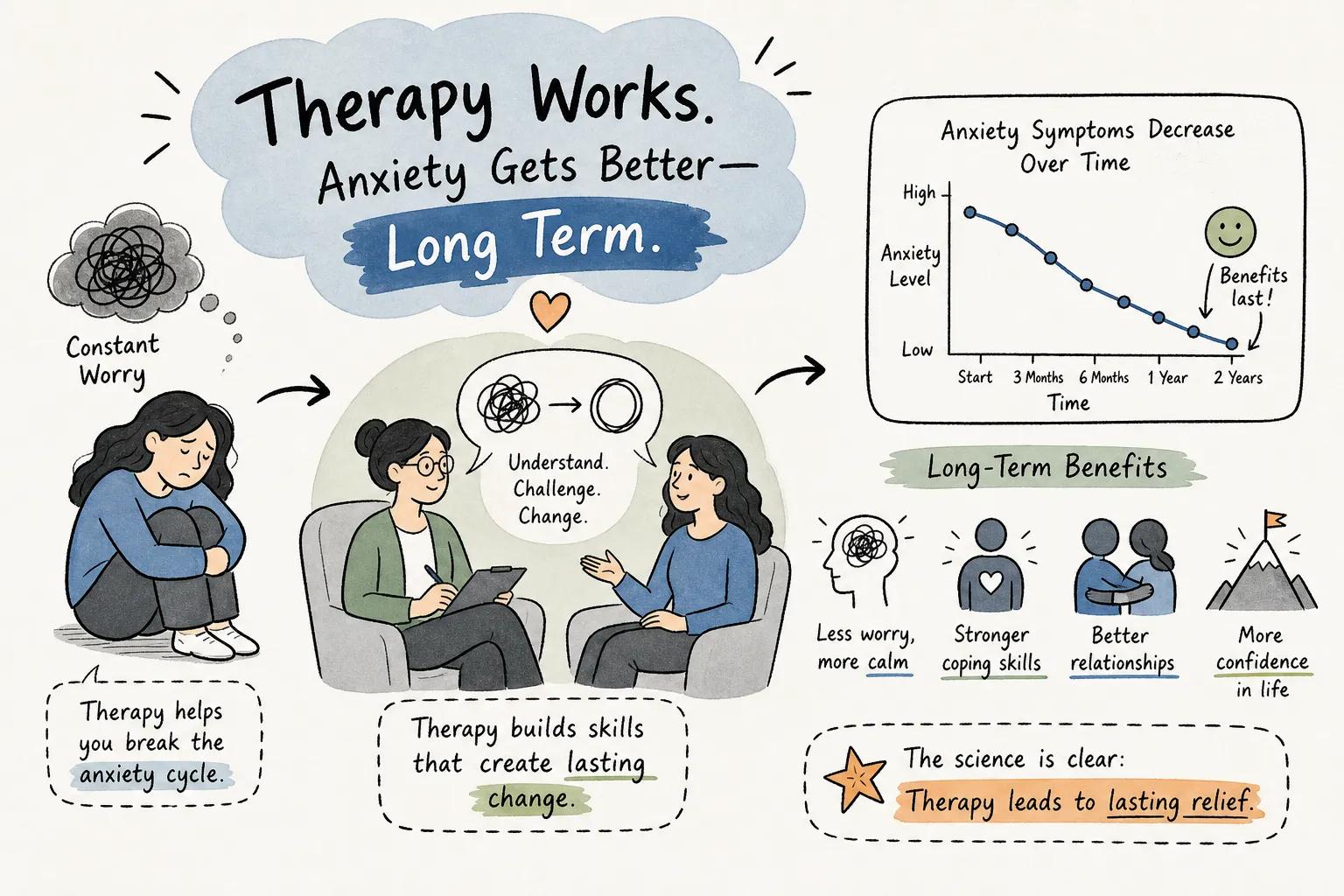

CBT, ACT, EMDR, CFT and the rest explained plainly, with what the evidence says works best for anxiety and for depression.
You've been told you need therapy. Maybe your GP said it, maybe a friend suggested it, or maybe you've reached the point where you know yourself that something has to change. But beyond "get some help," nobody has clearly explained which kind of therapy you actually need, or why the distinction matters. That gap is frustrating, and it's more common than it should be. If you're wondering which type of therapy is best for anxiety and depression, this guide walks through the main evidence-based options honestly and without jargon, so you can make a more informed decision before you begin.
Psychological therapy options are genuinely confusing, even for people who've done some reading on the subject. CBT, ACT, EMDR, IPT, MBCT, psychodynamic therapy: these terms get used interchangeably in some circles and treated as completely separate disciplines in others. The reality is that therapy type matters almost as much as starting therapy at all. A mismatched approach doesn't just slow progress, it can leave people feeling like therapy "doesn't work for them" when the real issue was a poor clinical fit.
This article compares the main evidence-based options for anxiety and depression: CBT, ACT, MBCT, IPT, psychodynamic therapy, and EMDR. By the end, you'll have a clear enough picture to know which approach likely fits your situation, and what to do next. One thing worth knowing upfront: specialist private clinics, including Inkind Psychology Clinic, offer structured assessments designed to match clients to the right therapeutic approach before treatment begins. Most people don't realise that option exists.
Which type of therapy is best for anxiety and depression: a quick guide
How anxiety and depression usually show up together
Anxiety and depression frequently co-occur, and that overlap changes which therapy produces the best outcomes. Research on transdiagnostic CBT, including the Unified Protocol, shows that symptom domains interact in ways that a single-diagnosis approach can miss. A therapy designed purely for depression may leave anxiety unaddressed, and vice versa. This is why a blanket "just try CBT" recommendation, while often correct, sometimes misses important clinical nuance. Understanding the best type of therapy for anxiety and depression means accounting for both conditions, not treating them in isolation.
The factors that shape which therapy fits you
The key variables that influence therapy fit include whether your symptoms are driven primarily by thought patterns, avoidance behaviours, relationship difficulties, trauma history, or recurring relapse cycles. Therapy format matters too: some approaches are highly structured and goal-focused, while others are more exploratory. Your own goals play a role as well. Symptom reduction and deeper personal understanding are both valid aims, but they point toward different therapeutic models. Getting clarity on these factors before choosing a therapy isn't optional, it's foundational.
CBT: the most widely recommended starting point
How CBT works in practice
Cognitive Behavioural Therapy operates by identifying the connections between thoughts, feelings, and behaviours. Sessions are structured and goal-focused, with the therapist and client working together to spot unhelpful thinking patterns and avoidance behaviours, then testing and changing them through specific techniques. Think of it as a practical toolkit for rewiring how your brain responds to distress. It doesn't require years of deep self-exploration, just engagement with a clear, structured process.
What outcome research and NICE guidance say
NICE recommends CBT as a first-line psychological treatment for most anxiety disorders and depression. Meta-analyses have reported response rates of roughly 50% for anxiety at post-treatment, with broadly comparable figures for depression, though results vary across studies and populations. Importantly, transdiagnostic CBT addresses both anxiety and depression together and performs about as well as disorder-specific CBT, which matters significantly for people with overlapping symptoms. Gains also tend to hold at long-term follow-up, and some longitudinal research suggests relapse risk may be lower following CBT than after medication is discontinued, though this comparison is nuanced and condition-specific.
Who CBT suits best
CBT works best when specific thought patterns, avoidance behaviours, or panic responses are the main drivers of distress. It's particularly strong for panic disorder, social anxiety, health anxiety, phobias, and depression with identifiable negative thought cycles. If you can point to specific situations that trigger your anxiety, or specific thoughts that fuel your low mood, CBT gives you the tools to work with those directly. For many people, it remains the clearest answer to which type of therapy is best for anxiety and depression, but it isn't the right fit for everyone.
ACT and MBCT: when acceptance changes the equation
What separates ACT from standard CBT
Acceptance and Commitment Therapy doesn't try to change or challenge anxious thoughts. Instead, it teaches clients to step back from those thoughts and act in line with their values regardless of what the mind is saying. This "psychological flexibility" model suits people who have spent years fighting their own thinking and found it exhausting. Research suggests outcomes are broadly comparable to CBT across anxiety and depression for many presentations, though some reviews indicate CBT may have an edge for depression specifically. ACT's focus on building lasting flexibility, rather than targeting individual symptoms, may support durability, though the evidence on this is still developing.
MBCT and why it's built for relapse prevention
Mindfulness-Based Cognitive Therapy combines CBT structure with formal mindfulness training. Its strongest evidence base is in preventing relapse in recurrent depression: NICE specifically recommends MBCT for people who have experienced three or more depressive episodes. It is less typically used as a first-line treatment for severe active symptoms, but as a maintenance approach it's highly effective. The distinction matters because MBCT and acute CBT serve different clinical purposes.
The right candidate for mindfulness-based approaches
People who struggle with rumination, self-critical loops, or who want a sustainable long-term skill rather than short-term symptom management tend to respond well to ACT and MBCT. If your pattern involves thoughts that spiral and replay, rather than discrete panic triggers, these approaches often fit better than standard CBT. That said, if your current symptoms are severe and active, starting with a more symptom-focused intervention first is usually the better clinical choice.
IPT and psychodynamic therapy: when the root is relational
IPT and depression driven by life events or relationships
Interpersonal Therapy focuses directly on the link between symptoms and interpersonal stress: grief, relationship conflict, role transitions such as divorce or redundancy, and social isolation. For depression with a clear interpersonal trigger, IPT achieves response rates of around 50 to 60% in clinical trials. It is time-limited, typically 12 to 16 sessions, and structured around improving communication and social functioning rather than modifying thought patterns. If your low mood clearly tracks a specific life event or relationship breakdown, IPT is worth considering seriously.
When psychodynamic therapy goes deeper
Psychodynamic therapy is the right fit when the issue isn't a single trigger but a recurring relational pattern that shows up across multiple relationships and life situations. It's especially suited to people with longstanding attachment difficulties, complex emotional histories, or personality-level interpersonal difficulties. Published meta-analyses show that psychodynamic therapy and CBT produce statistically equivalent response rates for adult depression at post-treatment, so the choice between them is less about effectiveness and more about what you're trying to address. If symptoms feel like symptoms of something deeper, psychodynamic work addresses the underlying dynamics rather than the surface presentation.
What to expect in terms of timeframe
IPT is short-term by design: most clients complete it in three to four months. Psychodynamic therapy can run from 12 sessions to longer open-ended work, depending on the depth of presentation. CBT typically sits in the range of 8 to 20 sessions. Knowing this helps set realistic expectations and choose an approach that fits your life, not just your symptoms.
EMDR: when trauma sits behind the anxiety or low mood
How EMDR differs from talk-based therapies
Eye Movement Desensitisation and Reprocessing (EMDR) doesn't rely on detailed verbal discussion of difficult memories. It uses bilateral stimulation, typically guided eye movements, while the client briefly focuses on a distressing memory, allowing the brain to reprocess it in a way that reduces its emotional charge. NICE recommends EMDR as a first-line treatment for PTSD and trauma-related presentations. Its mechanism, processing stored memories rather than analysing thought patterns, is distinct from the other psychotherapy options for anxiety and depression discussed here, which is one reason some people respond to it when talk-based approaches have stalled.
When anxiety or depression has a trauma component
Many people seek therapy for what looks like standard anxiety or depression without recognising that unresolved traumatic memories are maintaining the symptoms. EMDR is increasingly used for trauma-linked presentations beyond formal PTSD, including childhood adverse experiences that feed into adult anxiety and chronic low mood, though the evidence base outside PTSD is still developing. The strongest non-PTSD data currently covers panic disorder and specific phobias. Clinically, EMDR plays a meaningful role when anxiety or depression has a clear experiential root that hasn't been processed, but a thorough clinical assessment is the most reliable way to identify whether a trauma component is present and whether EMDR is the right tool to address it.
Matching the right therapy to your situation
Questions worth asking before you choose
Before settling on a therapy type, four questions are worth sitting with. Are your main struggles thought-based, relationship-based, or linked to specific past experiences? Do you want structured symptom work or something more exploratory? Have you been through multiple depressive episodes that keep returning? Is there a trauma history that hasn't been formally addressed? These aren't rhetorical, they're the exact questions a good clinical assessment will cover, and your honest answers point clearly toward some therapy types and away from others.
- Thought-driven anxiety and depression: CBT or ACT
- Recurrent depression or relapse prevention: MBCT
- Depression linked to a life event, loss, or relationship: IPT
- Recurring relational patterns or complex emotional history: psychodynamic therapy
- Trauma history maintaining current symptoms: EMDR
Why a personalised assessment matters
Self-selecting a therapy type from a list carries real risks. Picking the wrong fit can slow progress and, more damagingly, lead people to conclude that therapy simply isn't for them, when the real problem was a mismatch between their presentation and the model applied. At Inkind Psychology Clinic, structured assessments are conducted by experienced psychologists to map each client's individual presentation to the most appropriate therapeutic approach before any treatment begins. That process takes the guesswork out of what can otherwise feel like an overwhelming decision, and it's the clearest path through the confusion this article has laid out. Whether you're dealing with anxiety, depression, or both, getting that clinical picture first makes everything that follows more targeted and more effective.
FAQ: which type of therapy is best for anxiety and depression?
Is there one therapy that works for both anxiety and depression?
Not universally, but transdiagnostic CBT is specifically designed to address both conditions together, and research shows it performs comparably to disorder-specific approaches. ACT is another strong option for people whose anxiety and depression are intertwined. The best type of therapy for comorbid anxiety and depression depends on whether your symptoms are primarily thought-driven, trauma-linked, or rooted in relationship patterns.
How do I know which therapy is right for me?
The most reliable way is a structured clinical assessment with a qualified psychologist, not a self-diagnosis from an online list. A good assessment will map your specific symptom profile, history, and goals to the evidence-based therapies most likely to help, and just as importantly, rule out approaches that aren't the right fit.
What if I've tried CBT before and it didn't work?
This is more common than people realise, and it rarely means therapy won't work for you. It often means CBT wasn't the right match, either the timing wasn't right, or your presentation called for a different model. Trauma-linked anxiety may respond better to EMDR. Chronic relational patterns may need psychodynamic work. Recurring depression that keeps returning after remission is exactly what MBCT was designed for.
Start with the right fit, not just the first available option
Ultimately, the best answer to which type of therapy is best for anxiety and depression depends on your specific symptoms, your history, and what you're trying to achieve. CBT for thought-driven anxiety and depression. ACT and MBCT for psychological flexibility and relapse prevention. IPT for relationship-linked or life-event depression. Psychodynamic therapy for deeper relational patterns. EMDR for trauma-linked presentations. Each has a clear evidence base, a defined clinical purpose, and a population of people it serves well.
Treat this guide as a starting map, not a final answer. A qualified psychologist can turn that map into a clear, personalised direction with considerably more precision than any article can offer. The difference between reading about psychotherapy options for anxiety and depression and actually getting the right one comes down to a good assessment conversation.
If you're ready to stop guessing and get a clear clinical picture, reaching out to a specialist clinic is the logical next step. Inkind Psychology Clinic works with adults, young people, and couples across the UK, both online and in person. The first step is a conversation, and that's exactly where Inkind starts.