Why fighting anxiety tends to feed it, explained through the three emotion systems, and what to do instead of arguing with your own mind.
Have you ever noticed that the harder you try to stop feeling anxious, the worse it gets? That the more you argue with your worry, tell yourself to calm down or try to push through it with willpower, the tighter the knot in your chest becomes?
You are not imagining it. And you are not failing. What is actually happening is that you are using your brain's threat system to fight your threat system, and that only makes the alarm louder.
This is one of the most common patterns I see at UK Inkind Psychology. Clients arrive exhausted from months or years of trying to defeat their anxiety through sheer force of will. They tell me they feel weak for not being able to stop worrying, as though willpower should be enough. But the problem was never weakness. Nobody explained to them how their emotional systems actually work, and once you understand that, the picture changes completely.
Paul Gilbert, Professor of Clinical Psychology at the University of Derby and founder of the Compassionate Mind Foundation, developed a model that makes sense of exactly this pattern. After years of working with NHS patients who understood their problems intellectually but could not shift how they felt, Gilbert proposed that our brains operate through three interconnected emotion regulation systems. He called this the three circles model. Understanding these three systems changes how you relate to anxiety and gives you a practical way forward.
What the three circles model actually is
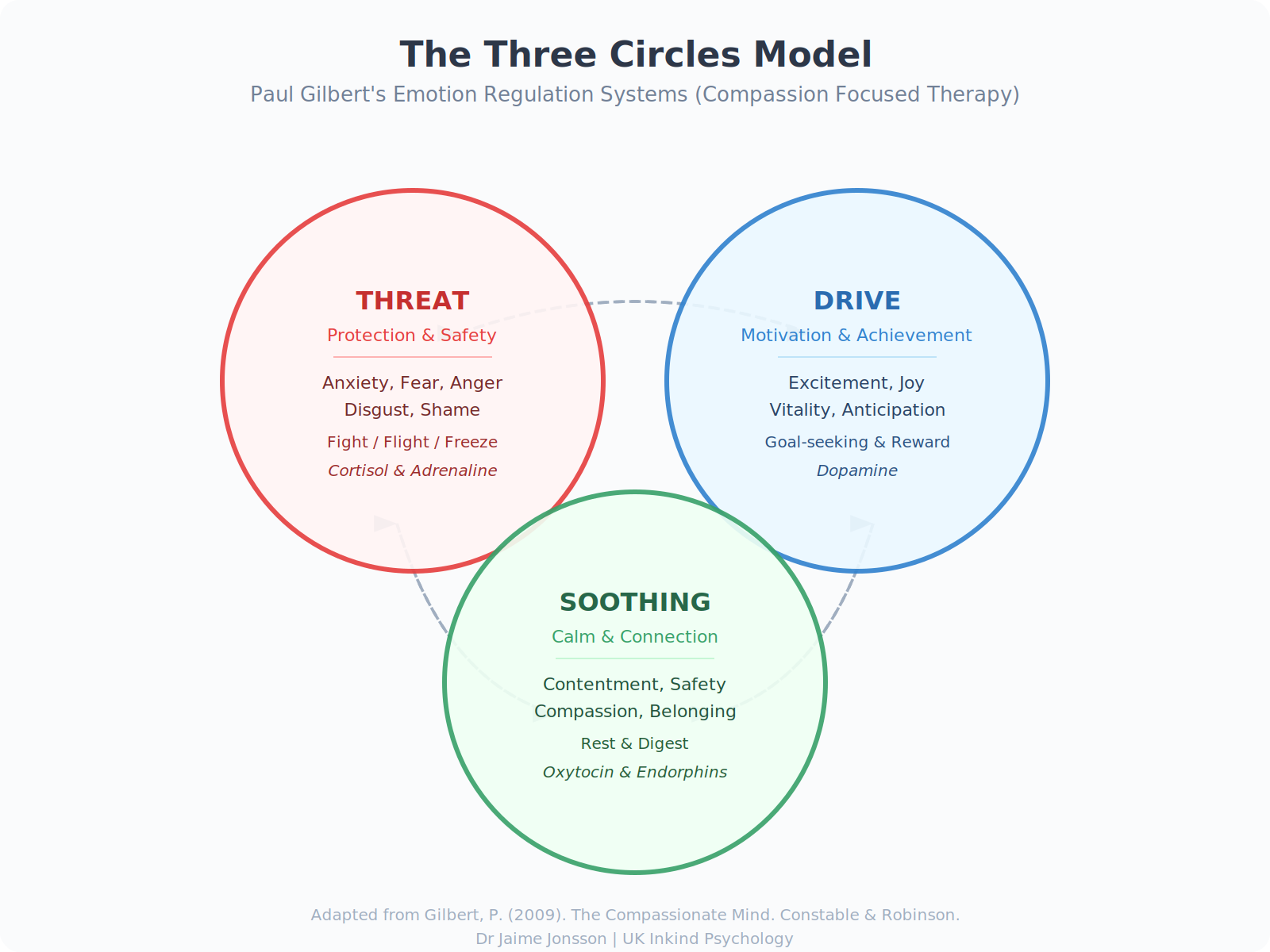
The three circles model is a framework from Compassion Focused Therapy (CFT) showing that your brain regulates emotion through three distinct but connected systems: the threat system, the drive system, and the soothing system. Each has a different evolutionary purpose, produces different neurochemicals, and creates different feelings and behaviours.
These three systems interact constantly. When they are reasonably balanced, you feel stable and able to handle what life throws at you. When one system dominates, particularly the threat system, you struggle. The goal is never to switch any system off. All three exist for good reasons. The goal is balance.
Think of it like a mixing desk in a recording studio. Each channel needs to be at the right level relative to the others. Turn the threat channel too high and everything sounds distorted. Cut the soothing channel entirely and the overall mix sounds harsh. The skill is learning to adjust those levels, and that is something you absolutely can learn to do.
The threat system (red circle): your internal alarm
The threat system evolved to detect danger and get you to safety as fast as possible. It triggers emotions like fear, anxiety, anger, shame and disgust. When it fires, your body floods with cortisol and adrenaline. Your heart rate climbs, your breathing becomes shallow, and your thinking narrows to focus entirely on the perceived problem (Sapolsky, 2004).
This system operates on what researchers call a "better safe than sorry" principle. It would rather sound a false alarm one hundred times than miss a real threat once. For our ancestors, hearing a rustle in the grass and assuming it was a predator kept them alive. That bias towards caution served our species well for thousands of generations.
The problem? Your threat system cannot tell the difference between a lion and a looming work deadline. It responds to an angry email from your manager with broadly the same neurochemical cascade it would produce if you were being physically chased. I see this constantly in my work at UK Inkind. Clients describe their hearts pounding before meetings, lying awake running through worst-case scenarios at 3am, or snapping at their partner over trivial things. Their threat system is doing exactly what evolution designed it to do. It just was not designed for office politics, social media or 24-hour news.
One thing I always explain to clients is that the threat system also processes internal threats. Self-criticism activates the same alarm as external danger. So when you tell yourself "I should cope with this" and feel ashamed that you cannot, your threat system registers that shame as yet another danger signal. You end up anxious about being anxious, which is a vicious cycle that is incredibly common and absolutely not your fault.
The drive system (blue circle): ambition and reward
The drive system motivates you to pursue goals, seek resources and achieve things. It produces feelings of excitement, enthusiasm, anticipation and pleasure when you hit your targets. The primary neurochemical here is dopamine, the same chemical involved in the reward pathways activated by everything from career success to social media notifications.
This system is essential. Without it, you would have no motivation to get out of bed, pursue a career or build relationships. But it has a feature that many people do not recognise: the drive system is activating, not calming. The buzz you feel after closing a deal or finishing a project feels good, but it is not the same as feeling safe and settled. It is a "wanting" feeling, not a "having" feeling. That distinction matters enormously.
I work with many driven, professionally successful people who cannot understand why they feel anxious despite having everything they thought they wanted. They earn well. Good relationships. Every box ticked. But their internal experience is relentless pressure. That is because they have been bouncing between drive and threat without spending meaningful time in their soothing system. Drive pushes them forward. When they stumble or fear failure, threat takes over. When the threat passes, drive kicks back in. Round and round, with no rest.
Does that sound familiar? When drive becomes excessive, it starts to look remarkably like anxiety. The restlessness, the inability to switch off, the checking of emails at midnight. Some clients describe this shift from drive to threat as sudden. One moment they feel energised and focused. The next they are catastrophising about everything that could go wrong.
The soothing system (green circle): the one most people neglect
The soothing system produces feelings of contentment, safety, calmness and connection. It is associated with oxytocin and endorphins rather than cortisol or dopamine. When this system is active, your parasympathetic nervous system engages. Your heart rate slows, your breathing deepens, and your prefrontal cortex comes back online, which means you can think clearly, see the bigger picture and make considered decisions rather than reactive ones.
Gilbert linked this system specifically to affiliative behaviour, the warmth, care and kindness we experience in close relationships (Gilbert, 2009). When a parent soothes a distressed child, the child's threat system calms because their soothing system has been switched on by the parent's tone, touch and presence. The good news? As adults, we can learn to activate this system for ourselves. That is the core therapeutic mechanism behind Compassion Focused Therapy.
Here is what I notice in practice. Most clients who come to me with anxiety have a massively overdeveloped threat system, a moderately active drive system, and an almost non-existent soothing system. When I ask them what they do to genuinely soothe themselves, many struggle to answer. Some confuse distraction with soothing. Scrolling your phone, having a glass of wine or binge-watching a series are not soothing activities in this sense. They are drive activities (seeking stimulation) or avoidance strategies (escaping threat). True soothing involves connecting with genuine feelings of safety, warmth and belonging.
Why fighting anxiety makes it worse
This is the insight that changes everything for most of my clients. When you try to fight, argue with or push away your anxiety, you are responding to a threat-system activation with another threat-system response. You are treating your own feelings as the enemy. Your brain registers this internal battle as yet another thing to be alarmed about.
The result is escalation. You feel anxious. You get frustrated with yourself for feeling anxious. That frustration is anger, a threat emotion. Now your threat system has two reasons to stay activated: the original worry and your anger about the worry. Clients describe this as a spiral, and they are right. It is a feedback loop where threat feeds threat, and each lap around the loop raises the emotional temperature another degree.
The way out is not to fight harder. It is to change the system you are operating from. Instead of trying to defeat your threat system, which only activates it further, you need to bring your soothing system online. The soothing system does not compete with threat. It regulates it. When oxytocin rises, cortisol falls. When your parasympathetic nervous system engages, fight-or-flight naturally quietens. You do not need to force anything. You need to create the right conditions.
What imbalance looks like in daily life
When I introduce the three circles model in therapy, I ask clients to draw the three circles sized according to how much time they spend in each system. Try it yourself right now. Grab a piece of paper and draw three circles: one red (threat), one blue (drive), one green (soothing). Make each one bigger or smaller depending on how present that system has been in your life over the past week.
Someone with anxiety typically draws a massive red circle covering most of the page, a medium blue one, and a tiny green one. Sometimes the green is barely a dot. Burnout shows a different pattern: the blue drive circle has grown large and started bleeding into red, because the person has been running on ambition and adrenaline for so long that drive has exhausted itself and flipped into chronic threat.
Depression often presents with a dominant threat system, particularly shame and self-criticism, alongside a collapsed drive system where motivation has drained away and the soothing system feels blocked. A 2025 study published in Scientific Reports validated a digital version of the three circles assessment and found that threat system dominance predicted higher scores on measures of anxiety, depression and stress, while soothing system activity predicted lower scores across those same measures (Petrocchi et al., 2025).
These imbalances are not your fault. Our three emotion systems are shaped by experience across a lifetime. If you grew up in an unpredictable household, your threat system learned to stay on high alert. If achievement was the main way you received approval, your drive system became dominant. If you rarely experienced consistent emotional warmth, your soothing system may never have fully developed. Gilbert is clear about this: these patterns are products of evolution and life experience, not personal failings (Gilbert, 2010).
Practical exercises to activate your soothing system
This is where the three circles model moves from interesting theory to something you can actually use today. These exercises are drawn from Compassion Focused Therapy and I use versions of all of them with clients at UK Inkind regularly.
Soothing rhythm breathing
This is the foundational CFT exercise and the first thing I teach most clients. It directly engages your parasympathetic nervous system through the vagus nerve. Here is how to do it:
- Get comfortable. Sit with your feet flat on the floor, hands resting in your lap. Close your eyes or soften your gaze downwards.
- Breathe in through your nose for a count of four. Let your belly expand rather than your chest.
- Breathe out through your mouth for a count of six. The longer out-breath is the key part. It stimulates the vagus nerve and activates your parasympathetic response directly (Jerath et al., 2006).
- Repeat for two to three minutes. Focus on the rhythm rather than precise counting. You want a smooth, steady pace that feels comfortable, not forced.
- Notice the shift. Even when it is small, that slight change in your body is your soothing system beginning to come online.
I recommend practising this twice daily for two weeks before judging whether it works. Your brain needs repetition to build new pathways. The first few attempts often feel odd or even uncomfortable, particularly if your threat system runs hot. That is normal and it does not mean you are doing it wrong.
Compassionate imagery
Once soothing rhythm breathing feels familiar, this exercise builds on it. After settling into your breathing rhythm, bring to mind an image of a compassionate being. This could be a real person, a grandparent, a teacher, a close friend. It could be a fictional character, a spiritual figure, or something entirely imagined. The key qualities are that this being genuinely cares about you, is wise enough to understand your difficulties without judgement, and is strong enough to sit with your pain without being overwhelmed.
Spend a few minutes imagining this being looking at you with warmth. What expression do they have? What might they say? How does it feel to be in their presence? This exercise activates the same brain regions, specifically the insula and prefrontal cortex, that respond to actual compassionate contact with another person. Your brain does not fully distinguish between vividly imagined compassion and real compassion. Both bring the soothing system online (Gilbert, 2010).
The three circles check-in
This one you can do anywhere, any time, and it takes under a minute. Simply pause and ask yourself: which system am I in right now? Am I in threat? Am I in drive? Am I in soothing? There is no wrong answer. The point is awareness. Once you notice which system is dominant, you have a choice about whether to stay there or consciously shift towards another. Over time, this simple act of noticing starts to change the balance on its own.
When to consider professional support
The three circles model works well as a self-help tool. But it also forms the foundation of Compassion Focused Therapy, a structured therapeutic approach with growing evidence behind it. A 2023 systematic review and meta-analysis in the Journal of Affective Disorders found that CFT produced significant improvements across depression, anxiety, self-compassion and psychological distress (Craig et al., 2023).
If your anxiety is persistent and significantly affecting your daily life, or if you find it genuinely difficult to access feelings of warmth and safety even with practice, working with a trained therapist can make a real difference. CFT is available through some NHS Talking Therapies services, where you can self-refer without needing a GP referral. Privately, you can find CFT therapists through the BABCP or HCPC register.
I want to be honest about the evidence too. CFT research is promising but still developing. Most studies use relatively small samples, and the participant demographics skew heavily towards women. Gilbert himself describes the three circles as a useful "rule of thumb" rather than a rigid scientific taxonomy. The model simplifies genuinely complex neuroscience into something clinically workable. That is its strength, but it means you should treat it as a compass, not a GPS.
Take the first step
Anxiety is not something you defeat through force of will. It is something you learn to regulate by understanding your emotional systems and deliberately bringing your soothing system into the picture. The three circles model gives you a framework for that understanding, and the exercises above give you practical tools to start shifting the balance today.
Start with soothing rhythm breathing. Twice a day, for two weeks. Notice what changes.
At UK Inkind Psychology, our clinical psychologists specialise in helping people understand and work with their emotional systems rather than fighting against them. If you would like to explore whether Compassion Focused Therapy might be right for you, we offer a free 15-minute consultation. Click the Book Now button at the top of the page or visit our contact page to get started.
You do not have to sit with this on your own.
About the author
Dr Jaime Jonsson is a Consultant Clinical Psychologist and founder of UK Inkind Psychology. She holds a Doctorate in Clinical Psychology from Newcastle University, where she specialised in CBT and psychodynamic psychotherapy. Dr Jonsson is registered with the Health and Care Professions Council (HCPC) and the IHPU Swedish Psychology Institute, and is recognised by Bupa. With over 20 years of clinical experience across NHS and private settings, she draws on Compassion Focused Therapy, CBT, EMDR and systemic approaches to support clients with anxiety, depression, trauma, burnout and relationship difficulties. She offers online consultations UK-wide through UK Inkind.
Frequently asked questions
What is the three-circle model?
The three circles model is a framework from Compassion Focused Therapy developed by Professor Paul Gilbert at the University of Derby. It proposes that your brain regulates emotion through three connected systems: the threat system (fear, anxiety, anger, shame), the drive system (motivation, excitement, goal-pursuit), and the soothing system (calmness, contentment, connection). Mental health difficulties often arise when these systems are out of balance, particularly when threat dominates, and soothing is underactive.
Can I use the three circles model without a therapist?
Yes. The model works well as a self-help framework. Exercises like soothing rhythm breathing, compassionate imagery and the three circles check-in can all be practised independently. Gilbert's book The Compassionate Mind (2009) is a good starting point. If your anxiety is severe or long-standing, working with a CFT-trained therapist will give you more structured support and help you work through blocks that are harder to shift alone.
What is the difference between CFT and CBT for anxiety?
CBT focuses on identifying and changing unhelpful thought patterns and behaviours. CFT builds on CBT but adds a specific focus on developing self-compassion and activating the soothing system. For people who understand their thinking patterns but still struggle to feel different emotionally, or whose anxiety is maintained by self-criticism, CFT addresses what CBT alone sometimes misses. Many therapists, myself included, integrate both approaches.
How do I know if my threat system is overactive?
Common signs include persistent worry that jumps from topic to topic, difficulty relaxing even when nothing is obviously wrong, irritability over small things, physical tension in your shoulders, jaw or stomach, sleep difficulties, catastrophising, and a general feeling of being "on edge" without a clear cause. If several of those sound familiar, your threat system is likely dominant.
Is compassion-focused therapy available on the NHS?
CFT is available through some NHS Talking Therapies services, though availability varies by area. Some trusts run CFT group programmes lasting 8 to 12 weeks. You can self-refer without a GP referral. For private therapy, look for practitioners registered with the BABCP or HCPC who list CFT among their specialisms. At UK Inkind, we offer CFT as one of our core therapeutic approaches.
Does the three circles model help with depression, too?
Yes. Depression typically involves a dominant threat system driven by shame and self-criticism, a collapsed drive system with loss of motivation and pleasure, and a soothing system that feels blocked or inaccessible. CFT was originally developed specifically to help people with high levels of shame and self-criticism, which feature in both anxiety and depression.