How to tell a qualified online therapist from a convincing website: which registrations matter, what to ask, and the warning signs.
Many people who decide they need support encounter barriers almost immediately. NHS waiting lists stretch for months, credential acronyms blur together, and every platform seems to make exactly the same promises. Online therapy UK searches return hundreds of results, but having more options doesn't automatically make the decision easier. If anything, the sheer volume of choices creates its own kind of paralysis.
This guide cuts through that. By the end, you'll understand what remote therapy actually involves, how to weigh up NHS and private routes, how to confirm a therapist is genuinely qualified, what a realistic session costs in 2026, and how to book a first appointment without second-guessing yourself. Throughout, we'll use Inkind Psychology Clinic, a UK psychology clinic delivering online therapy for adults, young people, and couples, as a reference point for what professional virtual therapy looks like in practice.
What online therapy UK actually involves
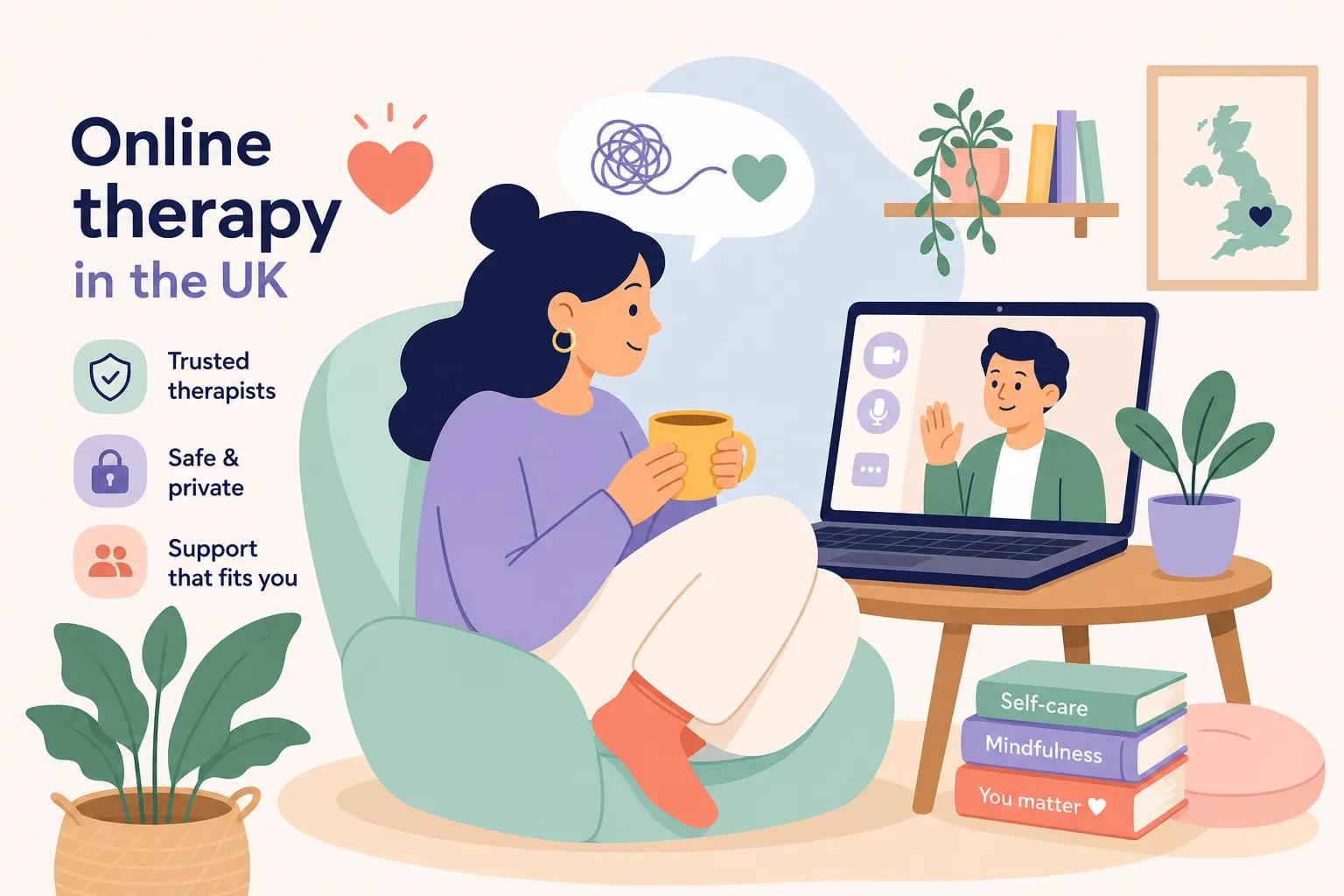
Online therapy isn't a single format. In the UK, it covers live video sessions, telephone appointments, and asynchronous text-based support. The clinical standard, what most regulated providers offer, is live video delivered over an encrypted platform: a private video call with a trained therapist, structured exactly as an in-person session would be.
The technology is simpler than people expect. You receive a secure link by email, click it at the appointment time, and join the session from a private space at home or wherever works for you. If the connection drops, the therapist will call you directly. Encrypted platforms used by regulated clinics meet UK GDPR and Data Protection Act 2018 requirements, so your session content is protected by law, not just policy.
How sessions are structured
Many therapists offer sessions of around 50 to 60 minutes, broadly the same as an in-person appointment. The therapist leads the session using the same clinical framework they would use face-to-face; the format hasn't changed, only the location. The first session is typically an assessment rather than an immediate deep dive into what's troubling you. The therapist gathers background, asks about your current difficulties, and begins to understand what you're hoping for. You don't need to prepare anything.
Importantly, the first session runs both ways. You're assessing the therapist just as much as they're assessing you. Reputable clinics, including Inkind Psychology Clinic, offer a structured initial assessment before any ongoing therapy plan is agreed, giving both parties clarity from the outset rather than locking you into a commitment before you know whether the fit is right.
Which therapy types translate well to video
CBT (Cognitive Behavioural Therapy) is the most widely delivered modality remotely, with strong evidence for anxiety and depression. Psychodynamic therapy and person-centred counselling both translate well to video, since they rely primarily on dialogue and the therapeutic relationship rather than physical techniques. EMDR (Eye Movement Desensitisation and Reprocessing) for trauma is now routinely delivered online; NHS and independent service evaluations have reported significant reductions in PTSD symptoms through remote EMDR, making it a practical option for those who can't attend in person (see the benefits of EMDR therapy for trauma recovery for more detail). The modality that suits you best depends on your presenting difficulty, not the format.
NHS, charity, and private routes: what each option actually offers
The three main pathways for accessing online counselling UK-wide are NHS Talking Therapies, third-sector and charity providers, and private psychology clinics. Each serves a different need and comes with different timescales.
NHS Talking Therapies (formerly IAPT) offers free digital programmes including SilverCloud for guided self-help and Mindler for typed CBT. In England, adults can self-refer directly without a GP. In Scotland, Wales, and Northern Ireland, a GP referral is typically required first. Digital programmes can offer near-immediate access, but a full course of therapist-led sessions may still take weeks to begin.
Waiting times vary considerably by local service. While NHS England data indicates that the majority of Talking Therapies patients are seen within six weeks, some areas report that a significant proportion of patients wait considerably longer for their first appointment, a pattern widely documented in healthcare commentaries and local NHS trust reports. NHS Talking Therapies is primarily designed for mild-to-moderate anxiety and depression. It is not built for complex presentations, trauma, ADHD, or couples therapy.
Charity and community counselling services may sometimes have shorter waiting times than local NHS services, though this varies by provider and area. They typically offer a limited number of sessions (usually 6 to 12) and a narrower clinical range. For moderate-to-complex needs, or when speed and specialist expertise genuinely matter, private teletherapy is the practical choice. It offers faster access, a broader range of modalities, and the flexibility to schedule around work and family commitments.
How to check a therapist is properly qualified
This is the step most people skip, and it's the most consequential. In the UK, the title "counsellor" or "therapist" is not legally protected. Anyone can use it without formal training. The title "psychologist" is similarly unprotected unless the person is registered with the HCPC (Health and Care Professions Council) as a Practitioner Psychologist.
The main accrediting bodies you need to know are: BACP (British Association for Counselling and Psychotherapy), UKCP (UK Council for Psychotherapy), NCPS (National Counselling and Psychotherapy Society), BABCP (British Association for Behavioural and Cognitive Psychotherapies), and HCPC for registered psychologists. Accredited registers like BACP, UKCP, and NCPS are PSA-accredited registers, meaning the Professional Standards Authority independently oversees their standards. Being "accredited" by one of these bodies means more than simply being a member; it requires supervised clinical hours, ongoing continuing professional development, and adherence to an ethics code.
How to verify registration in under two minutes
Ask the therapist for their full name, the body they are registered with, and their membership number. Go to that body's public register on its official website, search the name, and confirm the registration is current. If a name doesn't appear in the register, treat that as a serious concern and seek clarification before proceeding. The whole process takes less time than reading a therapist's profile page but tells you significantly more.
The red flags to watch for: vague credentials listed as "trained in CBT" with no professional body named; no membership number offered; no mention of professional indemnity insurance; no clear complaints process. A legitimate, qualified therapist will welcome these questions without hesitation. If they deflect, that's your answer.
What online therapy sessions cost in the UK in 2026
Private online therapy UK-wide currently averages around £55 per session, with the broader range sitting between £36 and £90 depending on the therapist's experience and specialism. Clinical psychologists and highly experienced practitioners typically sit at the higher end of that range. Weekly therapy at £70 per session works out to £280 per month; many clients find fortnightly sessions financially sustainable without significantly reducing therapeutic progress.
Some platforms offer a reduced first appointment; others charge a standard session rate from the first booking. Some regulated clinics provide a free introductory call before the first paid session so you can assess the fit without financial commitment. Clarify the cancellation policy before booking, since many practitioners require 24 to 48 hours' notice to avoid a charge.
Free and low-cost routes worth knowing about
NHS Talking Therapies digital programmes are free and accessible. Charity and community services often operate on a sliding-scale fee or no fee for those on low incomes. Some private clinics operate under a social enterprise model: Inkind Psychology Clinic states that it provides limited free therapy to people who are unable to access or afford support, funded through its wider private practice. That kind of dual model is relatively uncommon in the UK private sector and worth investigating if cost is a barrier.
Using health insurance to pay for therapy
Several major UK health insurance providers, including Bupa, AXA Health, Vitality, and Aviva, cover private psychology sessions. The process usually involves obtaining a referral code from your insurer before booking your first appointment. Check your policy for annual psychological therapy limits and whether a GP referral is required before the insurer will authorise sessions. A regulated clinic that works directly with insurers removes much of that administrative burden from the client's side.
How to choose and book your first online session
Professional directories, specifically BACP's "Find a Therapist" and the UKCP register, list verified therapists with searchable specialisms. They're a reliable starting point. Subscription platforms like BetterHelp or Online-Therapy.com offer faster algorithmic matching but operate as marketplace models rather than clinically supervised networks. For complex presentations, including trauma, ADHD, or relationship difficulties, a regulated clinic or a directory-sourced online therapist UK-based with demonstrable specialist training is the stronger choice.
What to ask before committing
Before you pay for a first session, ask the following: what is your therapeutic modality and how does it apply to my specific difficulty? Which professional body are you registered with, and what is your membership number? Do you work with health insurance providers? What is your cancellation policy? A good therapist welcomes these questions; the answers tell you whether the fit is right before any money changes hands.
Why booking through a structured clinic simplifies everything
Booking through a clinic rather than an individual freelance therapist offers practical advantages that aren't immediately obvious. A clinic handles clinical matching to the right psychologist for your needs, maintains secure systems already compliant with UK data protection law, and provides an established complaints route if anything goes wrong. Inkind Psychology Clinic works with adults, young people, and couples across the UK via online sessions, accepts a range of major health insurance providers, and is staffed by qualified psychologists. That removes much of the verification work this article has outlined, because a well-structured clinic has systems in place to handle it.
Putting it all together: your next steps with online therapy UK
Virtual therapy in the UK is genuinely accessible and more affordable than most people assume. For many presentations, private routes can offer faster access than waiting for NHS provision, though timescales vary by area and need. The barrier isn't the technology or the availability; it's knowing where to look and what questions to ask.
The five steps are straightforward: understand the format, compare your route options, verify the therapist's credentials, clarify the cost including any insurance entitlement, then book an introductory call before committing to ongoing sessions. None of those steps are complicated once you know what to look for.
Finding the right therapist is a practical, verifiable decision. Whether you choose Inkind Psychology Clinic or another regulated practice, the right support is within reach. Book a free introductory call with a regulated online therapist UK and take the first step today.