What private medical insurance typically does and does not cover for mental health, and why claims are so often declined.
Picture this: you've been paying into a private medical insurance policy for years, feeling reassured that your health is covered. Then one day you find yourself struggling: you book a therapy session and discover that the claim is rejected. Or partially paid. Or only valid if you jump through a series of hoops you didn't know existed. Experiences like this are more common than they should be, and they're almost always the result of a gap between what people expect private medical insurance mental health cover to include and what the policy actually says.
Private medical insurance does cover mental health treatment in the UK, but the rules are nothing like those for a physical diagnosis. There are session caps, acute condition requirements, pre-existing condition exclusions, and authorisation steps that can catch people completely off guard. The situation becomes more complicated once you factor in moratorium periods, financial caps, and insurer-specific approved provider lists. Understanding how these policies actually work before you need to use one makes an enormous difference.
This article covers the core of what you need to know about private medical insurance and mental health: what UK private health insurance typically includes, what it excludes, how insurers assess your history, what it costs, and how to access treatment through your cover. At Inkind Psychology Clinic, we work with clients navigating insurance-funded treatment every day, and we see firsthand where the gaps tend to appear.
What UK Private Medical Insurance Covers for Mental Health
PMI does cover mental health, but the coverage is built around a specific type of condition: acute episodes. These are new, short-term conditions with a clear treatment pathway and a realistic endpoint. If your mental health need fits that definition, your policy may well fund your treatment. If it doesn't, you'll need to understand the limits before relying on it.
Whether mental health is included as standard or as an optional add-on varies by policy tier and insurer. Always check your documentation carefully, because a standard policy from one provider may include mental health outpatient therapy, while a similarly priced policy from another provider treats it as a paid upgrade. Private medical insurance mental health cover is not a single, consistent thing, it's a spectrum of benefits shaped by what you've paid for and how your insurer classifies your history.
Outpatient therapy: what's included and how many sessions
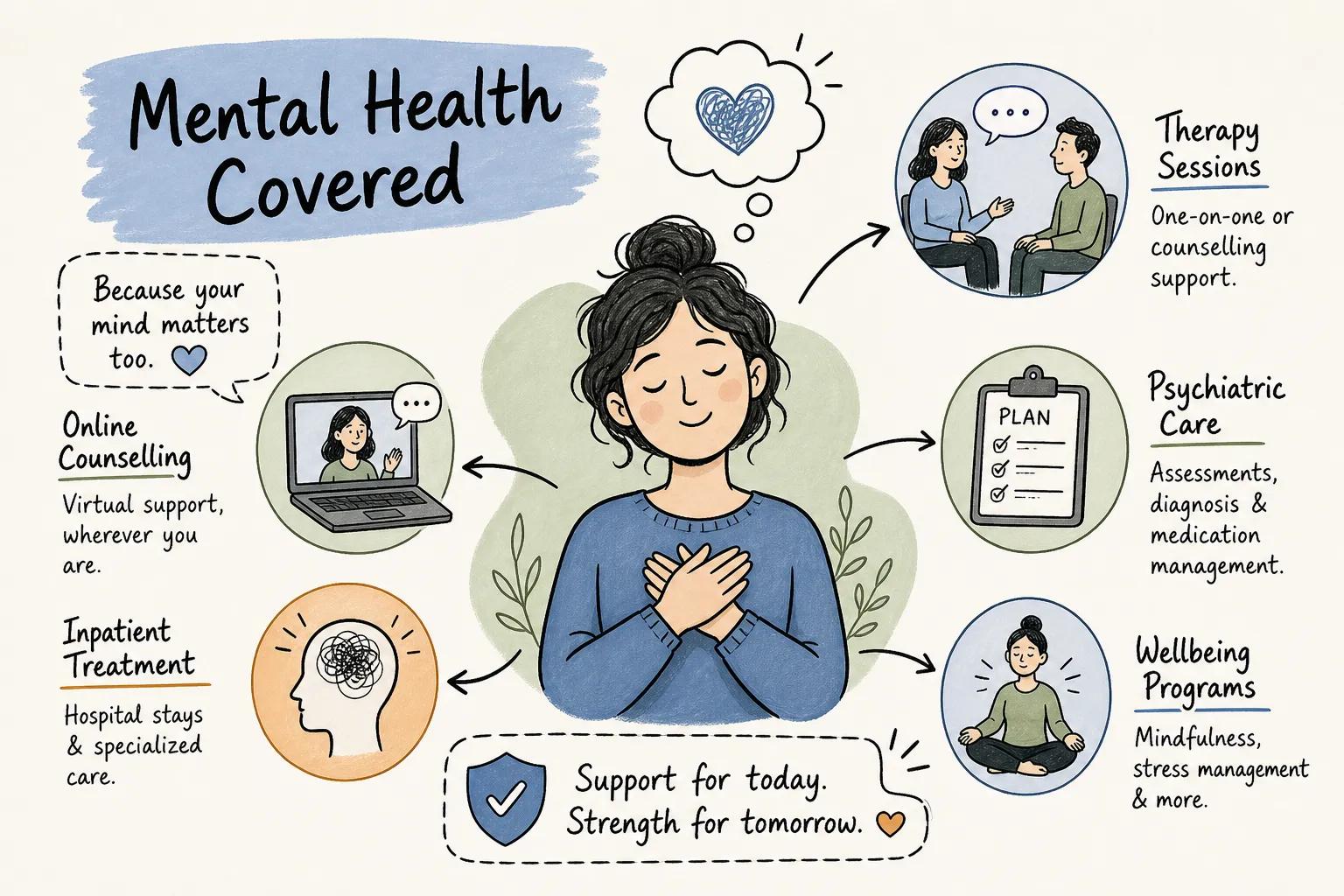
Outpatient talking therapies, including CBT and counselling, are the most commonly covered mental health treatment under UK PMI. Most standard policies cap sessions at between 6 and 20 per year, with a financial limit typically ranging from £750 to £2,500. Mid-range policies commonly sit at 8 to 10 sessions annually, which is enough for a focused, structured course of treatment for an acute episode.
Insurers apply these limits either as a fixed session number or as a monetary cap, whichever runs out first. Private therapy rates typically range from around £75 to £150 per session, varying by location, practitioner grade, and specialism. On that basis, a £2,000 annual cap translates to roughly 13 to 26 sessions depending on your provider's fees. All treatment must be delivered by an insurer-approved professional for the claim to be accepted.
Inpatient psychiatric care
Higher-tier policies include cover for inpatient psychiatric stays during acute crises, such as severe depression or eating disorders requiring hospital-based treatment. Day limits typically range from 28 to 90 days per year depending on the policy. This level of cover is reserved for the most serious acute episodes and requires pre-authorisation before admission.
The acute condition rule and why it matters
PMI is built on the assumption that conditions are short-term, treatable, and have a clear endpoint. A first episode of depression following a bereavement, for example, fits that model. The insurer funds treatment, you recover, the policy moves on. Once a mental health condition becomes persistent or requires ongoing management, standard PMI typically stops covering it. This distinction between acute and chronic is the single most important concept to understand before relying on your private medical insurance for mental health support.
What Most Private Medical Insurance Mental Health Policies Will Not Cover
PMI is designed for conditions that can be fixed, and mental health, by its nature, often doesn't fit that template. Before relying on a policy for ongoing psychological support, you need to know where the hard limits are.
Pre-existing mental health conditions
Any condition that was diagnosed, treated, or symptomatic before your policy started is almost universally excluded. This applies to anxiety, depression, and other conditions experienced in the two to five years prior to taking out cover, depending on which underwriting approach your insurer uses. This catches many people out, particularly those who sought help for a difficult period several years ago and assumed the slate was clean.
Chronic conditions, addiction, and developmental diagnoses
Long-term management of conditions such as bipolar disorder, personality disorders, and schizophrenia is excluded once the acute phase ends. Addiction treatment is either entirely excluded from standard policies or restricted to a single treatment programme over the lifetime of the policy, with no reinstatement at renewal. Neurodevelopmental diagnoses, including ADHD and autism spectrum conditions, fall outside standard PMI cover entirely. These conditions require separate assessment routes, and private ADHD assessments in particular are handled outside the PMI framework.
How Insurers Assess Your Mental Health History
One of the most common concerns people have is whether a history of mental health difficulties means they'll be refused cover altogether. The answer depends heavily on the underwriting approach your insurer uses, and on the specifics of your history rather than the mere existence of one.
Moratorium underwriting: the two-year qualifying window
Under moratorium underwriting, no detailed health disclosure is required at the point of purchase. Instead, the insurer automatically excludes any condition that was treated, symptomatic, or the subject of medical advice in the five years before the policy began. Providers including Bupa, Aviva, Vitality, and AXA Health use this approach. The mechanism for regaining cover is the two-year qualifying window: if two continuous years pass after the policy start date with no symptoms, treatment, or medical advice related to the condition, that condition may become eligible for future claims.
This sounds reassuring, but there's a catch. The moratorium review only happens at the point of a claim, so you won't know in advance whether a condition is covered. If any symptoms or consultations occur during the qualifying window, the clock resets entirely.
Full medical underwriting: declaration upfront
Full medical underwriting (FMU) requires a complete health history disclosure before the policy begins. Insurers assess the severity and recency of your history, looking at diagnosis type, medication stability, hospitalisations, and any crisis events such as self-harm or A&E attendance.
Validated scoring tools like the PHQ-9 for depression and the GAD-7 for anxiety inform this process. Mild-to-moderate scores on stable treatment often attract standard rates, while more complex histories may result in permanent condition exclusions or higher premiums. The key advantage of FMU is certainty: you know from day one exactly what is and isn't covered, which removes the ambiguity that moratorium policies carry.
The Real Cost of Adding Mental Health Cover to Your Policy
Many people are surprised to discover that mental health cover isn't always a standard inclusion. Depending on the policy and insurer, it may be bundled in, available as an add-on, or require an upgrade to a higher tier for comprehensive benefits.
What it costs on an individual policy
For policies where mental health is an optional add-on, the additional cost typically represents around 10% of the base premium, or roughly £10 to £30 per month. Example monthly premiums with mental health cover included range from approximately £38 to £46 depending on the insurer and excess level chosen. Many major insurers now include basic outpatient therapy within standard plans, making the incremental cost primarily relevant when you need enhanced inpatient cover or higher session caps.
Employer group schemes and what they usually include
Employer-funded PMI policies commonly include mental health support as part of the core package, typically covering helplines, digital CBT tools, and basic telephone counselling. Comprehensive inpatient psychiatric cover usually sits behind an upgrade tier. The same approximate 10% uplift in group premiums generally applies when an employer selects the enhanced mental health benefit. If you're covered through work, it's worth checking exactly which tier your employer has selected rather than assuming the full range of mental health benefits is available.
How to Access Mental Health Treatment Through Your Private Medical Insurance
Understanding your policy is one thing; actually using it is another. The process from recognising you need support to sitting in a first appointment has several steps, and missing any one of them can result in a rejected claim.
Getting a referral and pre-authorisation from your insurer
Most PMI policies require a GP referral before any mental health treatment begins; self-referral is generally not accepted. Once referred, the insurer must pre-authorise the treatment before sessions commence. Calling your insurer's mental health line at this stage, rather than after booking, saves significant time. You'll need your policy number, the GP referral letter, and details of the proposed treatment provider. Failing to complete the authorisation step before treatment starts is a frequent reason claims are rejected, so it's worth getting this right from the outset.
Some insurers, including Bupa and AXA, offer direct access pathways for certain types of talking therapy, allowing you to bypass the GP referral step for specific lower-level support. Check your policy documentation or call your insurer directly to confirm whether this option is available to you, as it can meaningfully reduce the time between recognising a problem and getting help.
Choosing an approved psychology provider
Insurers maintain lists of approved providers, and using a clinic outside that network means the claim will almost certainly not be accepted. This makes selecting the right provider one of the most practically important decisions in the process.
Inkind Psychology Clinic is registered with major UK health insurers and works with clients to confirm compatibility before treatment begins. The clinic's experienced, qualified psychologists deliver evidence-based therapy for anxiety, depression, trauma, stress, and more, for adults, young people, and couples. The team also handles the administrative side of the insurance process, which means you can focus on getting the support you need rather than navigating paperwork and authorisation codes.
Getting the Most from Your Private Mental Health Cover
Whether you're choosing a new policy or making sure your existing one actually works for you, a few practical checks go a long way.
Choosing the right policy tier before you need it
Before committing to a policy, check three things: whether mental health is included as standard or as an add-on, the session cap for outpatient therapy, and whether inpatient psychiatric cover is available. A mid-range policy with 10 to 12 annual sessions and a £2,000 financial cap represents a reasonable baseline for most people seeking therapy for an acute mental health episode. If you're likely to need more intensive or prolonged support, it's worth investing in the higher tier from the outset rather than discovering the limit mid-treatment.
How Inkind Psychology Clinic helps you use your cover
Having insurance cover and knowing how to activate it effectively are two different things. Inkind Psychology Clinic supports clients through every step of the process, from checking insurer compatibility to managing the referral and authorisation pathway. The clinic's psychologists are trained in a wide range of therapeutic approaches, including CBT, trauma-focused therapies, and EMDR, ensuring that whatever your insurer approves, the clinical quality is there to match it.
For anyone unsure whether their specific policy covers the treatment they need, Inkind's team can advise on compatibility and help you avoid the common pitfalls that result in unexpected bills or rejected claims.
Making Your Policy Work for Your Mental Health
Private medical insurance can be a genuinely useful route into high-quality mental health treatment, but only if you understand how it actually operates. The gap between what people assume their policy covers and what it actually does is wide, and it's almost always wider on the mental health side than any other area of healthcare.
When it comes to private medical insurance and mental health, the essentials are these: PMI covers acute conditions, not chronic ones; pre-existing conditions are excluded under almost all standard arrangements; session caps are real and finite; and the authorisation process must be followed before treatment starts. Knowing these rules in advance puts you in a much stronger position when you need support.
If you have private health insurance and want to understand whether your cover applies to the psychological support you're looking for, get in touch with Inkind Psychology Clinic. There's no pressure and no obligation, just a straightforward conversation about what's possible and how to get started.